Diamond Powder For Thermal Interface Materials
What This Process Needs To Solve
Diamond conducts heat better than any other bulk material — around 2,000 W/m·K for a good crystal against about 400 for copper. In a thermal interface material the job is not to conduct heat along the crystal but to build a continuous path through a polymer that conducts almost nothing. That makes loading and packing the controlling variables: the higher the diamond fraction, the more particle-to-particle contacts there are to carry heat, and the lower the bulk thermal resistance.
Loading is a packing problem
A single narrow size fraction leaves a large volume of polymer trapped between the particles. Blending two or three sizes — a coarse fraction that carries the load, a medium fraction that fills the holes between them and a fine fraction that fills what is left — reaches a far higher packing density at the same filler weight. Multi-modal blends are what lift a grease from 1–2 W/m·K to 5 W/m·K and above.
Viscosity, insulation and contamination
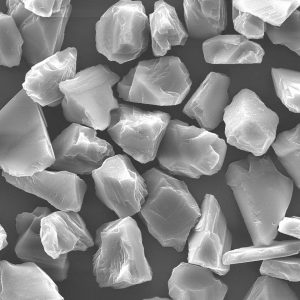
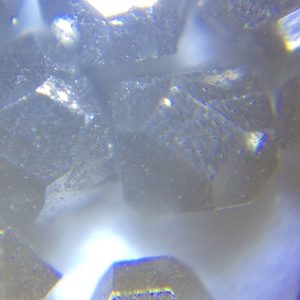
Adding filler also thickens the paste. Particle shape, surface treatment and the size window decide how much filler can go in before the material stops dispensing. Most of our TIM customers take blocky monocrystalline micron powder rather than sharp-edged crushed grit, because a regular crystal flows at higher loading. Where the compound has to stay electrically insulating, ionic content is controlled and reported on the batch certificate.
Recommended Grades And Size Ranges
Thermal fillers are specified by target thermal conductivity and target viscosity, and the blend is chosen to reach both. Sizes below are the windows our TIM customers order.
| Use | Recommended grade | Size range | Why this grade |
|---|---|---|---|
| Thermal gels, greases and gap padsSilicone, epoxy and polyurethane systems | |||
| Coarse load-bearing filler | HDY monocrystalline micron | 20 – 50 µm | Blocky crystals, highest packing density |
| Medium filler | HDY monocrystalline micron | 4 – 16 µm | Fills the gaps between the coarse fraction |
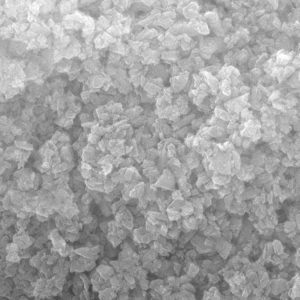
| Fine filler for hybrid blends | HDYM fine micron | W1 – W0.1 | Tops up the remaining voids, lifts total loading |
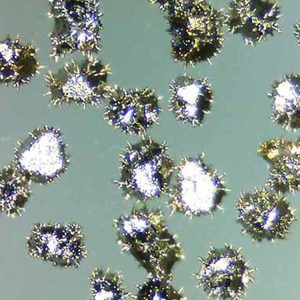
| Coated filler | HDY nickel- or titanium-coated | 1, 2, 4 µm | Better wetting and dispersion in resin |
| Metal matrix and sintered preformsDiamond–Cu, diamond–Al and diamond–SiC | |||
| Preform filler | HDY titanium-coated monocrystalline | 30 – 40, 36 – 54 mesh | Titanium coating secures wetting with copper |
Every TIM enquiry is quoted against a target W/m·K and a target viscosity. Send a reference sample and we match the blend, and report D10, D50, D90, moisture and metal-ion content on the batch certificate.
What has to hold
- High packing density from multi-modal blending
- Controlled particle size distribution
- High loading without raising viscosity
- Low ionic and metal contamination
- Nickel or titanium coating where the matrix needs it
Where it ships
Diamond Grades For This Process
Factory Direct Since 1990
Zhecheng Hongxiang Superhard Material Co., Ltd. is an integrated manufacturer and exporter of synthetic diamond powders since 1990, located in the Diamond Capital of China.
- Own manufacturing base in Zhengzhou, Henan — powder, coating and grading on one site.
- In-house particle size and SEM inspection on every batch before packing.
- Export packing with neutral or custom label, plus sample quantities for process trials.
What To Include
Describe your workpiece, process and target result. We will match the diamond grade from the existing product range.