
PTA hardfacing pushes diamond through a plasma arc into a melt pool running above 1,500 °C. Bare crystal does not survive that. What makes it work is a titanium coating that converts to TiC at the interface during the few milliseconds the particle is in the arc, plus an angular crushed shape that locks into the matrix as it freezes.
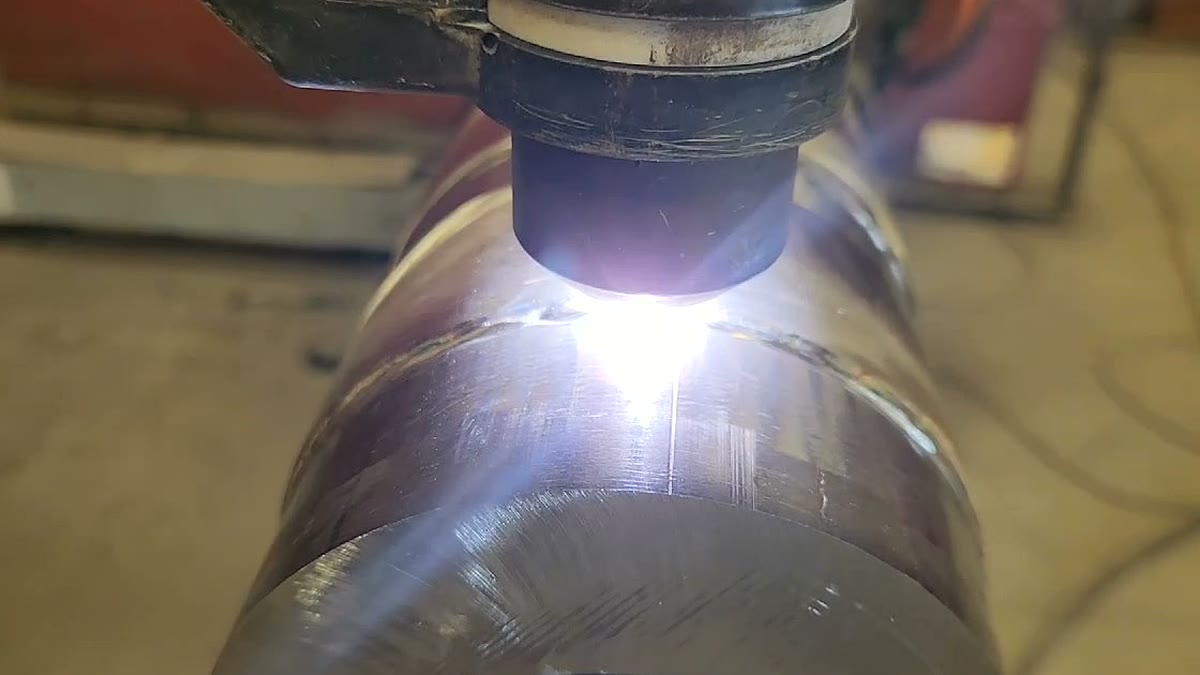
What The Arc Actually Does
PTA is not spraying. Powder is fed into a transferred arc, melted, and fused into a shallow melt of the workpiece itself, with dilution typically running 5 to 15 %. The diamond does not sit on a surface; it sits inside liquid metal that then freezes around it.
Two variables decide whether the crystal arrives intact: how hot the pool is, and how long the particle spends in it.
The Limit Is Time, Not Temperature
Diamond starts converting to graphite from roughly 700 °C in an inert atmosphere, and the conversion runs faster when the crystal is in contact with iron, nickel or cobalt, which dissolve carbon and catalyse the change.
A PTA pool is far above that. If temperature alone decided the outcome, no diamond would survive the pass. What saves it is duration: the particle crosses the arc and ends up in the deposit in tens of milliseconds, and then the pool freezes. Graphitisation is a kinetic process, so at that timescale only the surface reacts.
The practical consequence is that heat input and travel speed control the result more than the powder does. Slow passes, high current, and re-melting an existing bead all widen the time window, and all of them cost you diamond.
Titanium Coating Is A Bonding Layer, Not A Heat Shield
Titanium in contact with diamond begins forming TiC at around 680–700 °C. In PTA that reaction happens exactly where it is useful — at the interface, inside the arc, before the particle is swallowed by the pool. TiC is a carbide that the nickel-based matrix wets, so the crystal ends up chemically held rather than mechanically gripped.
It is worth being clear about what the coating is not. A film a few hundred nanometres thick cannot insulate a particle against a 1,500 °C pool for even a millisecond. The coating is designed to be consumed; its job is to become the bonding layer, not to shield the diamond from heat.
That also means the coating has to be intact when it reaches the arc. Titanium oxidises from a few hundred degrees in air, and an oxidised film forms titanium oxide instead of titanium carbide — a layer that bonds to nothing useful. Sealed, desiccated packing and a properly shielded process are part of the specification, not housekeeping.
Nickel Coating Behaves Differently In The Same Arc
Nickel coating is the correct choice for resin and metal bond tools, where service temperature is a few hundred degrees and the job is to give the bond a rougher, more wettable surface.
The same film does something else in PTA. Nickel melts at 1,455 °C and the nickel–carbon eutectic sits at 1,326 °C, so liquid nickel in contact with diamond dissolves carbon readily. In a pool at that temperature the coating stops being a barrier of any kind and becomes a solvent at the interface.
| In a PTA pool | Titanium coating | Nickel coating |
|---|---|---|
| Reaction with diamond | Forms TiC from about 700 °C | Dissolves carbon above the Ni–C eutectic (1,326 °C) |
| Bond in the deposit | Chemical, through the carbide | Wetting and mechanical |
| Role at 1,500 °C | Consumed into the bond | Acts as a carbon solvent |
| Where it belongs | PTA, vacuum brazing, carbide sintering | Resin bond, metal bond, electroplated tools |
Why Crushed Grit Holds Better
Crushed grit is angular, with a rough fractured surface. In a hardfacing deposit that shape does two separate jobs. The facets interlock with the matrix as it freezes, so the particle resists pull-out under impact. The exposed corners then act as micro-cutting edges when abrasive material moves across the surface.
Blocky or regularised grit flows better and packs more predictably in a feeder, which matters when diamond is blended into the matrix powder at a few percent by weight. The trade-off is genuine: very angular fines bridge in hoppers and feed unevenly, so a narrow band screened free of fines is usually worth more than a wider, cheaper one.
What To Put On The Order
For PTA the useful specification is short, and none of it is a mesh number:
- Size band in µm, and the method used to measure it
- Coating type and coating weight as a percentage, not as a coating grade name
- Crushed or blocky, and whether fines below the band are screened out
- Coating continuity — a batch with bare patches bonds only where the patches are not
- Packing and shelf life, because the coating loses its whole value to oxidation
Two powders quoted at the same mesh can behave completely differently in the same torch because of these five lines.
If The Deposit Underperforms
| Symptom | Likely cause | What to change |
|---|---|---|
| Dark spots, porosity, low diamond count in the bead | Heat input too high, arc time too long | Raise travel speed, reduce current, single pass |
| Particles pull out in service | Coating oxidised, or too little TiC formed | Check storage and gas shielding, confirm coating weight |
| Uneven distribution along the bead | Feeder bridging, band too wide | Narrower band, crushed grit with fines removed |
| Transverse cracks in the deposit | Matrix chemistry and cooling rate, not the diamond | Preheat and control cooling, review the Ni–Cr–B–Si balance |
Next Step
Titanium-coated diamond: titanium-coated diamond. Crushed grit in matched bands: HDHR crushed grit and HDYR crushed grit.
Background reading: nickel-coated versus titanium-coated diamond, and grit toughness and crystal shape. If the application is wear protection rather than cutting, send the working temperature and the matrix chemistry through contact us.
If you are buying rather than troubleshooting: the wear hardfacing grade table lists the recommended coating, size band and matrix for PTA, laser cladding, spray-fusing and Ni-Cr brazing.