
Diamond Powder For Fickert And Frankfurt Blocks
What This Process Needs To Solve
A slab polishing line is not one process run twenty times. Every head removes what the head before it left behind, and if one station stops cutting, the defect travels down the line and comes out as a dull band on a finished slab. The block body stays the same from calibration to buff. What changes is the diamond inside it — and that is where a line either holds its gloss or spends the shift chasing scratches.
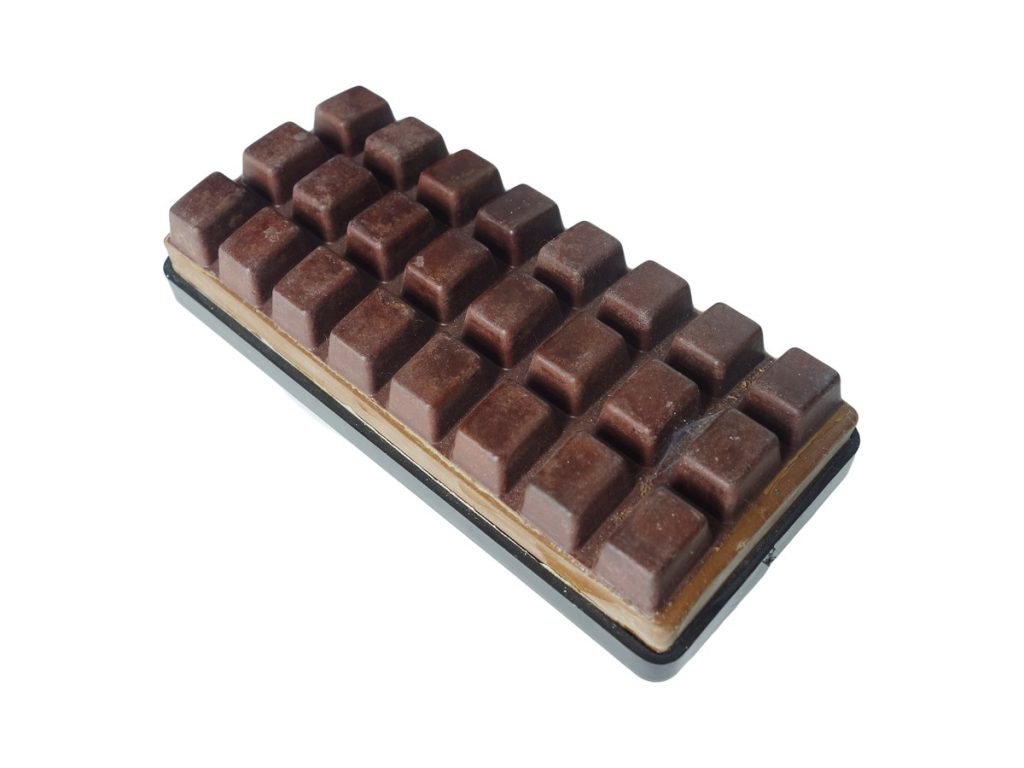
Frankfurt And Fickert Are Mounting Formats
Both names describe how a block is held, not what is in it. A Frankfurt block carries a dovetail that slides onto the head carriage. A fickert block sits on a clamped or hook-and-loop base. The same line often runs both, because the heads differ, and the abrasive inside is chosen by position on the line rather than by the name printed on the box.
Buying by format alone is how a calibration head ends up with polishing grade blocks. The slab still has its saw marks, the block does nothing to them, and the operator answers with pressure until the block body fails instead of the stone.
What The Coarse Heads Need
The first heads take the saw marks and the bow out of the slab, and they do it under impact. Water is present but not always where the contact is, so the crystal has to resist fracture first and stay sharp second. That is the MBD and SMD window, and it is the one place on the line where strength matters more than size.
By the polishing heads there is nothing left to break. The failure mode flips: the block has to cut without scratching, and one particle above the top cut drags a visible line across a face that was already closed two heads earlier. A band quoted on average size cannot predict that line. Only the upper cut can.
Where It Goes Wrong
- Straight scratch lines running the full width of the slab. A particle above the top cut trapped under the block, not a bond problem. Ask for the upper cut on that batch before changing anything else.
- Blocks shed their edge in the coarse heads. A resin body under an impact load; the diamond outlives the backing. Move calibration to metal bond, or to a coarser resin block.
- Amp draw climbs along the line and the face goes bright. The block has glazed and is rubbing instead of cutting. Bond too hard for the load, or the grit one step too fine.
- Shade difference between the two ends of one slab. A wide particle distribution: the coarse tail cuts, the fine tail polishes, and the mix shifts between batches. Grade on a narrow band and ask for D10 and D90 as well as the top cut.
What To Put In The Enquiry
- Head count, and which heads run coarse.
- Block format — dovetail or clamped — with the block dimensions.
- Slab width, line speed and water pressure at the heads.
- The grit sequence you run now, in mesh and micron.
- Stone type: granite, marble or engineered quartz.
Next Step
Send the head layout and the defect you are trying to clear — a scratch line, a glaze band, or a shade difference between slab ends — and we will quote a graded band against it. Every batch ships with a COA carrying the PSD curve, and trial quantities run before a production order.
If the work happens after the slab leaves the line — an edge cut on site, a repair, a small radius — the electroplated tool grades cover that side of the job.
Diamond Grades From Calibration To Buff
A slab line runs the same block body from the first head to the last, so the grade has to change while the format does not. The bands below follow the head, not the block.
| Head on the line | Recommended grade | Grit band | Why this grade |
|---|---|---|---|
| Coarse and calibration headsSaw marks, bow and thickness | |||
| Calibration head | MBD High-Strength Diamond Grit | 18/20 – 120/140 mesh | Impact load and uneven water; the crystal has to resist fracture before it has to stay sharp |
| Coarse grinding | HDYR Crushed Diamond Grit | 80/100 – 325/400 mesh | Friable grit renews at the block face instead of polishing the slab flat |
| Intermediate / honing | HDGR Crushed Diamond Grit | 100/120 – 325/400 mesh | Lower strength where the scratch left by the coarse head is already shallow |
| Finishing and polishing headsScratch removal and gloss | |||
| Pre-polish | HDG Micron Powder | W40 – W20 | Tight distribution; one straggler above the top cut drags a line across a closed face |
| Polish | HDY Micron Powder | W14 – W7 | Uniform crystal shape gives even gloss across the full slab width |
| Buff / final | HDY Micron Powder | W5 – W1 | Narrow top cut, so the last head does not reopen what the previous one closed |
Mesh bands follow the block heads; micron bands follow the polishing heads. A band quoted without a top cut cannot be used to predict a scratch line, which is the defect that scraps a finished slab.
What has to hold
- Head count and which heads run coarse
- Block format (dovetail or clamped) and block dimensions
- Slab width, line speed and water pressure at the heads
- Grit sequence you run now, in mesh and micron
- Stone type: granite, marble or engineered quartz
Where it ships
Diamond Grades For This Process
Factory Direct Since 1990
Zhecheng Hongxiang Superhard Material Co., Ltd. is an integrated manufacturer and exporter of synthetic diamond powders since 1990, located in the Diamond Capital of China.
- Own manufacturing base in Zhengzhou, Henan — powder, coating and grading on one site.
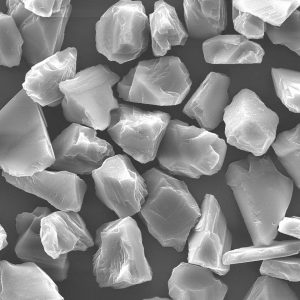
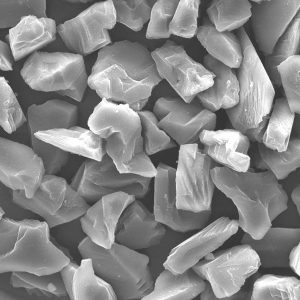
- In-house particle size and SEM inspection on every batch before packing.
- Export packing with neutral or custom label, plus sample quantities for process trials.


What To Include
Describe your workpiece, process and target result. We will match the diamond grade from the existing product range.